Running Locus behind the LiteLLM AI Gateway
LiteLLM ships an open-source proxy — variously branded the LiteLLM Proxy Server and the LiteLLM AI Gateway — that fronts 100+ model providers behind one OpenAI-shaped HTTP API.
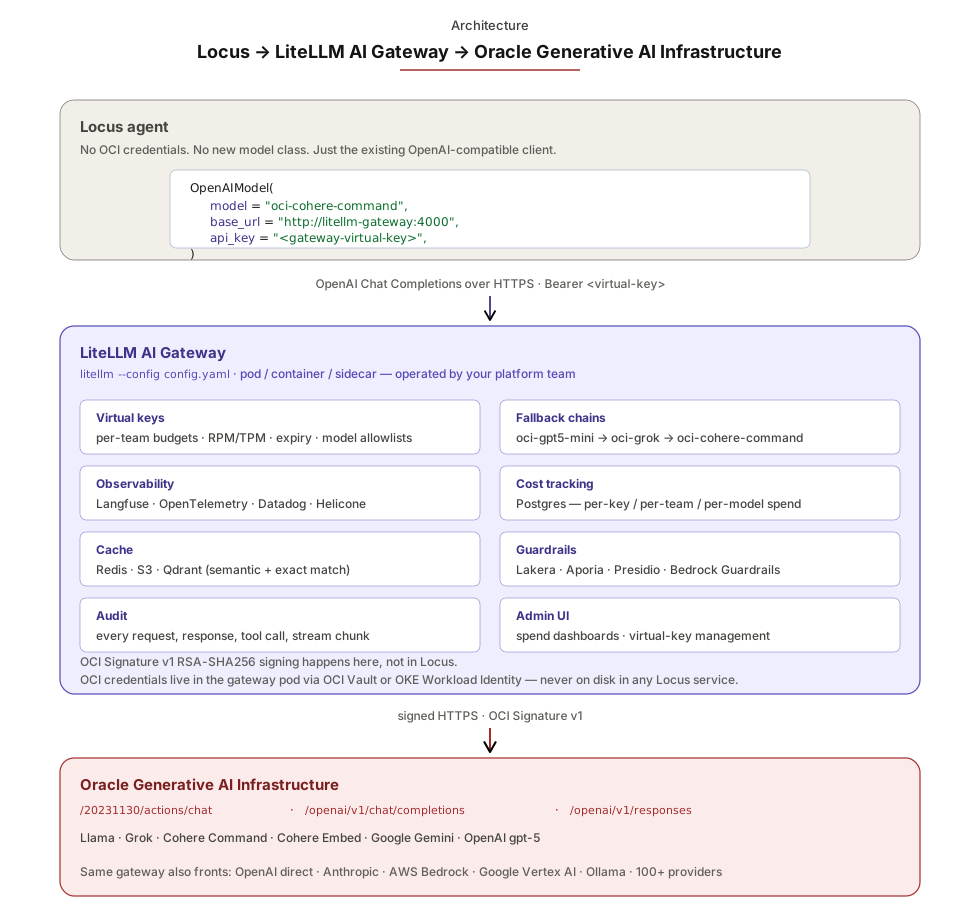
When you put it in front of Oracle Generative AI Infrastructure (and
optionally other providers), Locus consumes it through its existing
OpenAIModel with no Locus-side code
change. The gateway carries the parts of the integration that genuinely
belong in a gateway: virtual keys, per-team budgets, fallback chains,
centralised observability, cost reporting, caching, and guardrails.
Locus agent
   │  OpenAIModel(base_url="http://litellm-gateway:4000", api_key="<virtual-key>")
   ▼
LiteLLM Proxy Server  (config.yaml carries every provider + key)
   │
   ├──► OCI Generative AI  (/20231130/actions/chat — vendor adapters)
   ├──► OpenAI direct
   ├──► Anthropic
   ├──► AWS Bedrock
   └──► … 100+ providers
Scope: the gateway covers OCI's native API path only
LiteLLM's OCI provider targets OCI's native chat endpoint at
/20231130/actions/chat with vendor adapters (Cohere v1 transport
for cohere.*, GENERIC apiFormat for Grok / Llama / Gemini / gpt-5).
It does not wrap OCI's /openai/v1/chat/completions shim or
its /openai/v1/responses endpoint.
If you specifically need:
- the OCI OpenAI Chat-Completions V1 shim → use
OCIChatCompletionsModeldirectly. - server-stateful OCI Responses API (
previous_response_id, Responses-only models likeopenai.gpt-5.5-pro) → useOCIResponsesModeldirectly.
The gateway is the right answer for the OCI native path plus cross-provider routing; the direct providers are the right answer for OCI's other two surfaces.
Locus has zero litellm Python dependency — the package only
lives inside the gateway's Docker container. Your Locus services
only need openai (already pulled by OpenAIModel).
When to choose this over the direct OCI providers
Locus's direct OCI model providers remain the right default for single-tenant production, dev / CI, and on-OKE workload identity — they're simpler, in-process, lower-latency, and have no extra service to operate.
Reach for the gateway when you need:
- Multi-tenant key management — issue virtual keys per team / agent / customer with per-key budgets, RPM/TPM limits, expiry, and model allowlists.
- Fallback chains across regions or providers — "OCI us-chicago-1
→ OCI us-ashburn-1 → external Anthropic" defined in
config.yaml, no Locus restart. - Centralised observability — one Langfuse / OpenTelemetry / Datadog / Helicone hook configured in the gateway, every Locus service feeds it.
- Centralised cost tracking — Postgres-backed per-key / per-team / per-model spend reporting across every consumer.
- Polyglot consumers — Python Locus, JS workbench, Ruby / Go services all talk OpenAI to the same gateway.
- Caching across services — Redis / S3 / Qdrant in-flight, shared across every consumer.
If none of those apply, prefer the direct OCI providers. The gateway is an extra deployment, not a shortcut.
Quickstart — local Docker
The examples/litellm-gateway/ directory ships a working sample:
cd examples/litellm-gateway/

# Populate the OCI credentials the gateway will use to sign upstream calls.
# These live in the *gateway's* environment, not in your Locus app.
export OCI_REGION="us-chicago-1"
export OCI_USER="ocid1.user.oc1..xxx"
export OCI_FINGERPRINT="aa:bb:cc:..."
export OCI_TENANCY="ocid1.tenancy.oc1..xxx"
export OCI_KEY_FILE="$HOME/.oci/keys/your_api_key.pem"
export OCI_COMPARTMENT_ID="ocid1.compartment.oc1..xxx"

docker compose up
The gateway listens on http://localhost:4000 and exposes the model
aliases declared in config.yaml. The sample ships six:
oci-cohere-command, oci-cohere-embed, oci-grok, oci-gpt5-mini,
oci-llama-4-maverick, and oci-gemini-2.5-flash. Add more by
extending model_list.
Verify with a curl:
curl -s http://localhost:4000/v1/models \
  -H "Authorization: Bearer $LITELLM_VIRTUAL_KEY" | jq '.data[].id'
Issuing per-team virtual keys
The gateway's master key (LITELLM_MASTER_KEY) is the admin token —
treat it as a high-value secret and never hand it to a Locus
agent. Locus services should each carry a scoped virtual key
issued via the gateway's /key/generate endpoint:
curl http://localhost:4000/key/generate \
  -H "Authorization: Bearer $LITELLM_MASTER_KEY" \
  -H "Content-Type: application/json" \
  -d '{
    "models":   ["oci-cohere-command"],
    "max_budget": 5.00,
    "duration": "24h",
    "metadata": {"team": "platform-demo", "owner": "fede"}
  }'
Response (truncated):
{
  "key": "sk-<example-virtual-key-here>",
  "models": ["oci-cohere-command"],
  "max_budget": 5.0,
  "spend": 0.0,
  "metadata": {"team": "platform-demo", "owner": "fede"}
}
The gateway enforces every field at request time:
- Model allowlist — a key with
models: ["oci-cohere-command"]trying to calloci-gpt5-minigets rejected:key not allowed to access model. This key can only access models=['oci-cohere-command']. Tried to access oci-gpt5-mini. - Budget — when cumulative spend exceeds
max_budget, subsequent calls 429. - Expiry —
duration: "24h"automatically deactivates the key after 24 hours. - Metadata is attached to every request the key makes, so spend
reporting and audit logs can group by
team/owner/ whatever fields you put there.
/key/generate requires Postgres
The docker-compose.yml in this sample includes a Postgres sidecar
for virtual-key storage. Without it the gateway returns
{"error": "DB not connected"} for /key/generate. In production
point DATABASE_URL at an external Postgres (e.g. an OCI ADB
instance) so the gateway pod itself stays stateless.
Cost tracking
The same Postgres backend logs every request automatically with token counts and computed cost. No extra config beyond connecting the DB. The full admin / analytics API is documented at docs.litellm.ai/docs/proxy/cost_tracking; the snippets below cover the three endpoints the sample deployment relies on, with sample output captured live from this PR's validation run.
# Per-request spend log (flushed asynchronously every ~10s by default).
curl http://localhost:4000/spend/logs \
  -H "Authorization: Bearer $LITELLM_MASTER_KEY"

# Aggregate spend grouped by virtual key.
curl http://localhost:4000/global/spend/keys \
  -H "Authorization: Bearer $LITELLM_MASTER_KEY"
Sample output:
/spend/logs
  · model=oci/cohere.command-latest  tokens=11  cost=$0.000017
  · model=oci/cohere.command-latest  tokens=10  cost=$0.000016
  · model=oci/cohere.command-latest  tokens=9   cost=$0.000014

/global/spend/keys
  · key=sk-<example-vkey-1>...  total_spend=$0.000034
  · key=sk-<example-vkey-2>...  total_spend=$0.000014
LiteLLM ships an internal pricing table covering every model it
routes (so OCI's per-token pricing is applied automatically). Spend
is keyed by api_key, user, team_id, and any custom field in
metadata, so the same SQL surface answers "what did team X spend
this week?" and "what did model Y cost across all teams?".
The full admin / analytics API is documented at docs.litellm.ai/docs/proxy/cost_tracking.
Pointing Locus at the gateway
Use the existing OpenAIModel — that's the LiteLLM-compatible client:
from locus.agent import Agent
from locus.models.native.openai import OpenAIModel

model = OpenAIModel(
    model="oci-cohere-command",                  # alias from gateway config.yaml
    api_key="$LITELLM_VIRTUAL_KEY",                      # virtual key issued by the gateway
    base_url="http://localhost:4000",            # the LiteLLM AI Gateway
)

agent = Agent(model=model, system_prompt="You are concise.")
print(agent.run_sync("hi").message)
No new Locus class is needed. The gateway handles OCI RSA-SHA256
signing, vendor adapters (Cohere preamble / chatHistory, GENERIC
apiFormat for Grok / Llama / Gemini), fallback, budgets, and
observability internally. Locus only ever sees the OpenAI-shaped
HTTP contract.
Running existing notebooks through the gateway
Every examples/notebook_*.py already routes model construction
through examples/config.py:get_model(), which honors
LOCUS_MODEL_PROVIDER=openai plus the standard OPENAI_BASE_URL /
OPENAI_API_KEY env vars. So pointing every notebook at the gateway
is a four-line shell change — no code edits:
docker compose -f examples/litellm-gateway/docker-compose.yml up -d

export LOCUS_MODEL_PROVIDER=openai
export LOCUS_MODEL_ID=oci-cohere-command          # alias from config.yaml
export OPENAI_BASE_URL=http://localhost:4000
export OPENAI_API_KEY=$LITELLM_VIRTUAL_KEY                # gateway virtual key

python examples/notebook_06_basic_agent.py
python examples/notebook_07_agent_with_tools.py
# …
Deploying on OKE
The sample helm-values.yaml
in examples/litellm-gateway/ plugs into LiteLLM's official Helm chart
(ghcr.io/berriai/litellm-helm).
The recommended deployment shape is:
- One LiteLLM gateway Deployment per environment.
- OCI credentials wired in via Kubernetes secrets, sourced from OCI Vault (or via the gateway pod's OKE Workload Identity if you'd rather not mount a long-lived signing key at all — see "Authentication" below).
- Postgres for virtual-key state and spend logs.
- Service exposed cluster-internal only — Locus services hit it via
the in-cluster DNS name (
litellm-gateway.litellm.svc.cluster.local:4000).
Don't expose the gateway publicly — issuing virtual keys is your auth boundary, but the OCI credentials inside the gateway are not.
Authentication
The gateway changes the credential boundary:
| Without gateway | With gateway |
|---|---|
| Locus → OCI directly. Locus carries the OCI signing key (or uses OKE Workload Identity). | Locus → gateway with a virtual key. Gateway → OCI with the OCI signing key (or its own OKE Workload Identity). |
So Locus no longer needs OCI credentials at all — the gateway is the only thing that does. Locus only needs the virtual API key the gateway issued it. This is the central reason to deploy the gateway on a multi-tenant platform: agents from different teams use different virtual keys with different budgets, all hitting the same underlying OCI tenancy.
On OKE, run the gateway pod with workload identity targeting the OCI compartment, and OCI signing keys never have to land on disk anywhere.
What lives in config.yaml
The sample examples/litellm-gateway/config.yaml declares the OCI
provider entries (one per model you want to expose), a virtual-key
section (mock or Postgres-backed), and the global gateway settings.
The full schema is documented at
docs.litellm.ai/docs/proxy/configs.
Highlights:
model_list— every model alias the gateway exposes. The same alias is what Locus passes asmodel=toOpenAIModel.general_settings.master_key— the admin key that creates per-team virtual keys via/key/generate.router_settings.fallbacks— fallback chains across model aliases (e.g.[{"oci-gpt5-mini": ["oci-grok"]}]).litellm_settings.callbacks— observability hooks (Langfuse, OTel, Datadog, …).litellm_settings.cache— Redis / S3 / Qdrant caching config.
How enterprises use this pattern
The recurring deployment shape inside large organisations adopting LLMs across many teams is one gateway per environment, owned by a platform team, fronting every provider, accessed by every service.
The platform-grade pieces it earns them:
- Charge-back / showback — finance pulls a SQL report keyed on
virtual key +
teammetadata; per-team costs roll up without manual reconciliation. - Compliance, audit, data residency — append-only spend log (ISO-27001 / SOC-2 / PCI-friendly); PII redaction via guardrails before prompts leave the tenancy.
- Centralised governance — security/IT control which providers, models, and regions are approved; engineering can't bypass.
- Vendor diversification — declarative fallback chains across
regions and providers; application code stays one
OpenAIModelcall. - Quota arbitration — per-key
rpm_limit/tpm_limit/max_budgetlets the platform team fair-share shared vendor quotas. - Observability —
success_callback/failure_callbackpush LLM spans into the existing Datadog / OTel / Splunk pipeline. - Cost optimisation that compounds — cache identical prompts, route cheap requests to cheap models, identify top-spend prompts and rewrite them. All require centralised visibility.
- Polyglot consumers — Python Locus, JS workbench, Go / Ruby / Java services all talk the same OpenAI-shaped HTTP.
Deployment-shape table
| Layer | Owner | Lives in |
|---|---|---|
| OCI tenancy + IAM + signing keys | Cloud / security team | OCI Vault, OKE Workload Identity |
| Gateway pod + Postgres + Redis + obs backends | Platform / SRE team | Kubernetes (OKE), one deployment per env |
Gateway config.yaml (model catalog, fallbacks, callbacks, guardrails) |
Platform team | GitOps repo, change-controlled |
| Virtual keys + per-team budgets | Platform team issues; security reviews | Postgres; admin UI for issuance |
| Locus agents / workbench / other consumers | Application teams | Their own services, talking to litellm-gateway.<env>.svc.cluster.local:4000 |
| Spend reports + audit + alerts | Finance + security | SQL on the gateway's Postgres; obs dashboards |
The pattern lets the platform team set policy once and application teams consume it through a single contract — without anyone writing provider-specific integration code or holding provider credentials. LiteLLM's own enterprise documentation covers each surface (callbacks, cache, guardrails, audit) in depth.
See also
docs/how-to/oci-models.md— direct OCI providers (OCIChatCompletionsModel,OCIResponsesModel,OCIModel). The default for single-tenant deployments.examples/litellm-gateway/— workingconfig.yaml,docker-compose.yml, andhelm-values.yaml.- LiteLLM AI Gateway quickstart
- LiteLLM
config.yamlreference - LiteLLM Helm chart